LGBTQ+ and Suicide Prevention
The subject of suicide has always been a difficult conversation to have. Having an open conversation about mental health can be difficult, but speaking about suicide is still even more taboo for most people. However, one of the main ways to reduce suicide risk is to have an open conversation. Mental health is defined by the World Health Organization as “a state of wellbeing in which the individual realizes their own abilities, can cope with the normal stress of their life, can work productively and fruitfully, and can make a contribution to their community”1. Mental illness is a diagnosable illness that affects a person’s thinking, emotional state, and behavior. It can disrupt the person’s ability to work or carry out other daily activities and/or engage in satisfying personal relationships2.
When it comes to suicide rates, LGBTQ youth face a four times higher suicide rate compared to their peers3. Being LGBTQ does not necessarily mean the child will develop mental health issues, but it means they have a higher risk of developing such issues. Specific factors such as bullying, discrimination, rejection, and lack of safe spaces can heavily contribute to mental illness or suicide. Youth and young adults account for 14% of all suicides4. Overall, suicide is the 12th leading cause of death in the United States5. For LGBTQ youth, 45% seriously considered attempting suicide within the last year6.
Supporting LGBTQ youth can make a huge difference when it comes to minimizing mental illness and/or risk of suicide. Parenting can be difficult but the best thing you can do for your child is to learn how to accept them as they are even if you don’t understand everything regarding LGBTQ issues.
The acronym for LGBTQ is:
L: Lesbian: a woman who is sexually or romantically attracted to other women. Lesbians can also refer to themselves as gay.
G: Gay: relating to, or characterized by sexual or romantic attraction to people of the same sex. This word used to only refer to men but now can be used by anyone attracted to the same gender.
B: Bisexual: relating to, or characterized by sexual or romantic attraction to people of one's same sex and of the opposite sex9.
T: Transgender: relating to, or being a person whose gender identity differs from the sex the person had or was identified as having at birth10.
Q: Queer: relating to, or being a person whose sexual orientation is not heterosexual and/or whose gender identity is not cisgender11.
When it comes to suicide, there is no single cause. Many life events can create hopelessness and despair, which can contribute to suicidal behaviors.
Knowing the risk factors is very important. Below are some common risk factors provided by the national suicide hotline (988).
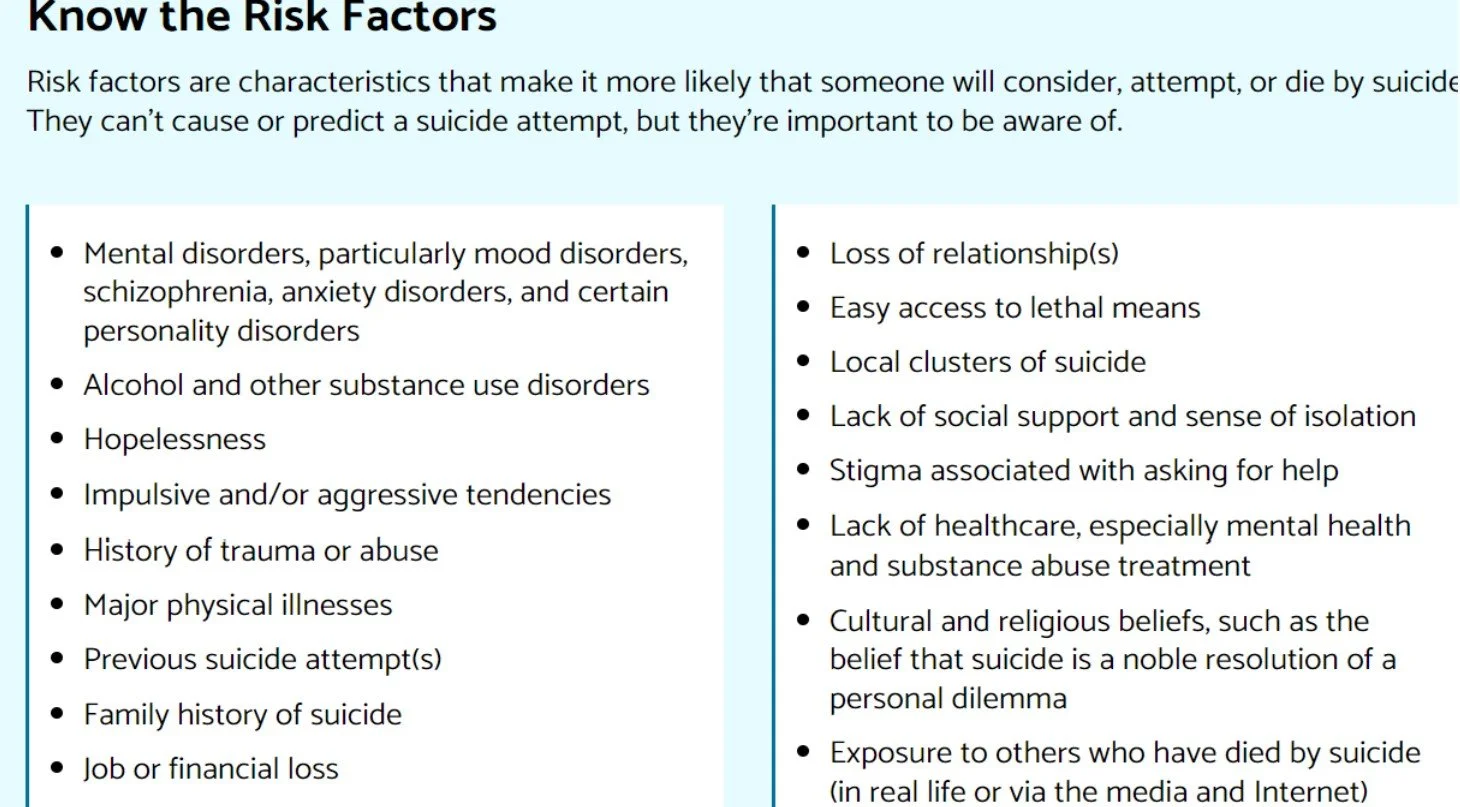
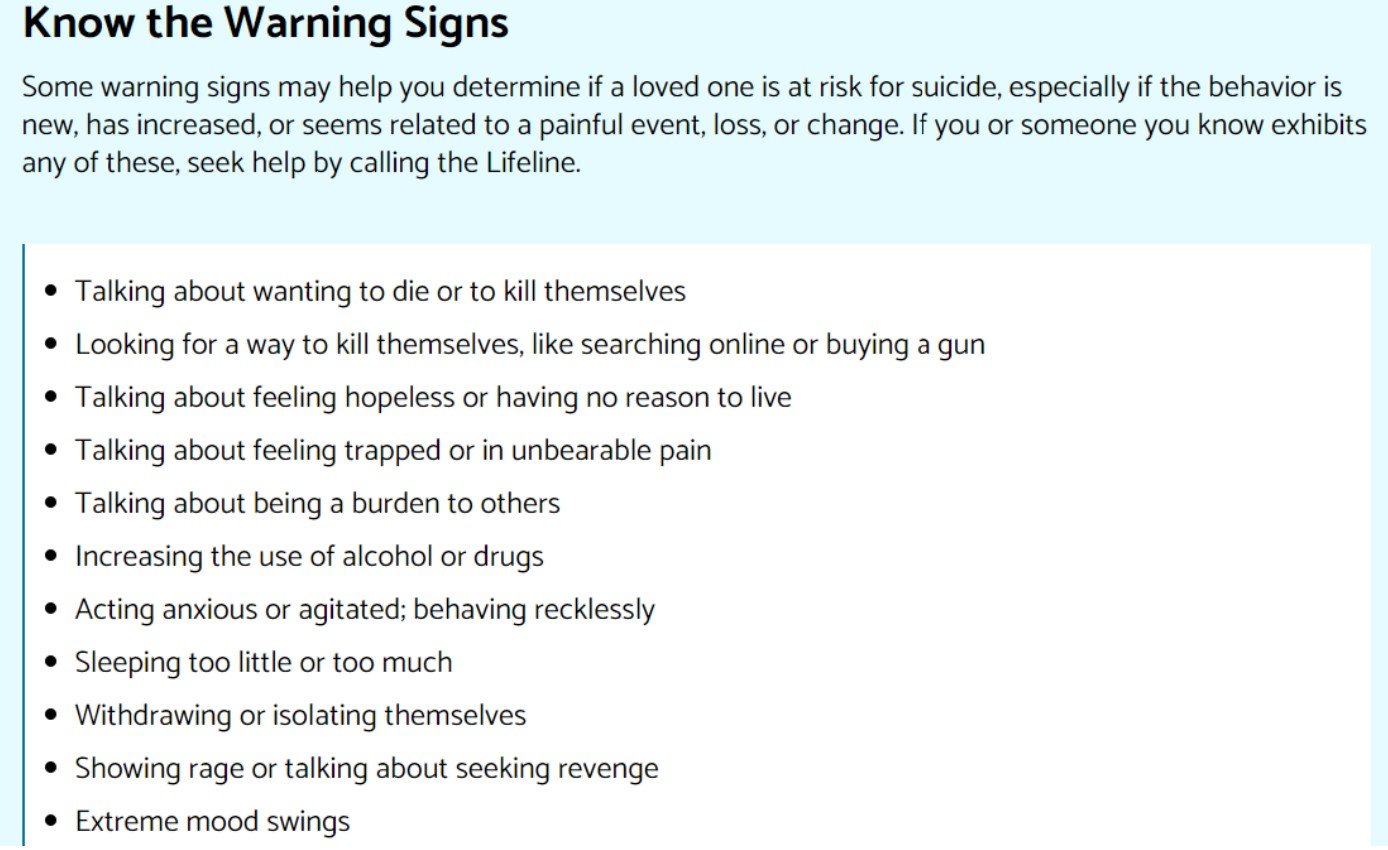
Many myths about suicide prevent people from talking with others who are at risk. Below are some examples:
How can you help someone who is contemplating suicide?12
1. Have an honest conversation
2. Talk to them in private
3. Listen to their story
4. Tell them you care about them
5. Ask directly if they are thinking about suicide
6. Encourage them to seek treatment or contact their doctor or therapist
7. Avoid debating the value of life, minimizing their problems or giving advice
If a person says they are seriously considering suicide12:
•Take the person seriously
•Stay with them
•Help them remove and reduce access to lethal means such as pills, guns, knives, or other weapons.
•Call the National Suicide Prevention Lifeline: 988 or text TALK to 741741 to text with a trained crisis counselor from the Crisis Text Line for free, 24/7
∙ Escort them to mental health services or, in severe cases, an emergency room
Suicide is preventable. Society must learn to speak about topics such as suicide to destigmatize mental health and keep the conversation going. When it comes to being a part of the LGBTQ community, we should remember that there are struggles when navigating sexuality. Support and love from family, friends, and communities are the best preventative factors with anyone who is struggling with mental health.
References & Resources:
1 World Health Organization: https://www.who.int/data/gho/data/themes/mental-health
2Mental Health First Aid Handbook: https://www.mentalhealthfirstaid.org/
3The Trevor Project: https://www.thetrevorproject.org/resources/article/facts-about-lgbtq-youth-suicide/ Research article citation: (Johns et al., 2019; Johns et al., 2020).
4 Center for Disease Control and Prevention: https://www.cdc.gov/suicide/facts/disparities-in-suicide.html
5 American Foundation For Suicide Prevention: https://afsp.org/suicide-statistics/
6 The Trevor Project: https://www.thetrevorproject.org/resources/article/facts-about-lgbtq-youth-suicide/
7 Meriam-Webster Dictionary—Lesbian: https://www.merriam-webster.com/dictionary/lesbian
8Meriam-Webster Dictionary—Gay: https://www.merriam-webster.com/dictionary/gay
9Meriam-Webster Dictionary–Bisexual: https://www.merriam-webster.com/dictionary/bisexual
10Meriam-Webster Dictionary—Transgender: https://www.merriam-webster.com/dictionary/transgender
11Meriam-Webster Dictionary—Queer: https://www.merriam-webster.com/dictionary/queer
12 How can you help someone who is contemplating suicide & If a person says they are seriously considering suicide: https://afsp.org/what-to-do-when-someone-is-at-risk